Boiler Pressure Low? How to Top It Up (5 Steps)
Boiler pressure low? It’s one of the most common reasons a boiler stops working, especially in winter. The good news is you can usually fix it yourself in about five minutes, without tools. Below, our Gas Safe engineers explain what your pressure gauge should read, how to top it up safely, and when low pressure means something needs repairing.
What should my boiler pressure be?
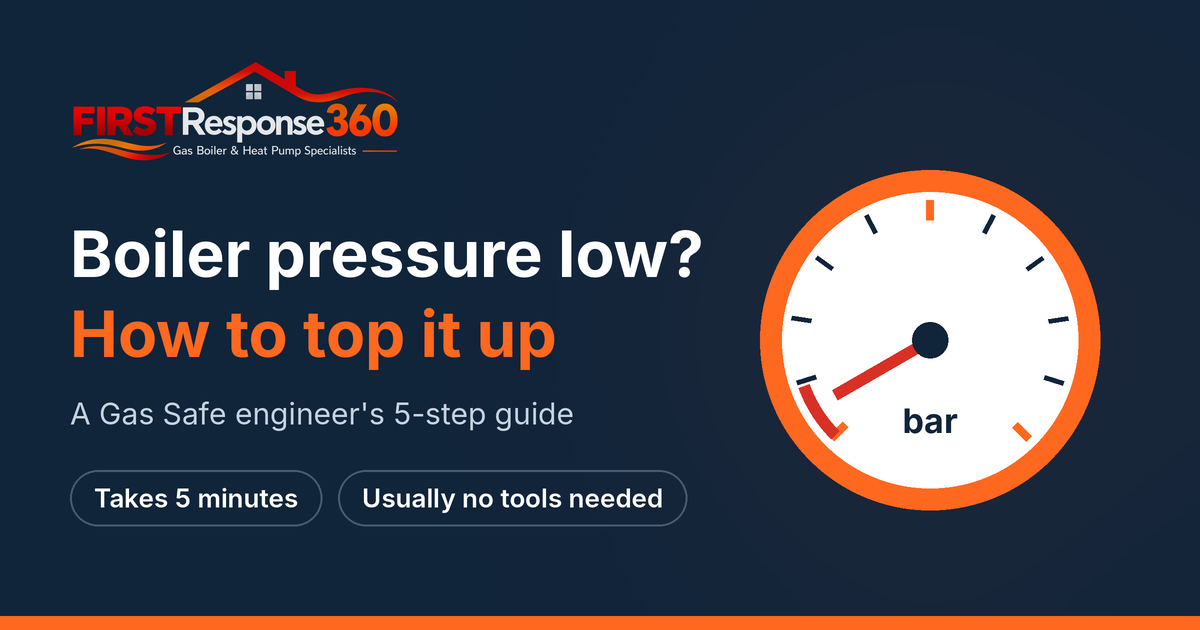
Most combi and system boilers should read between 1 and 1.5 bar when the heating is off and the boiler is cold. When the heating is running, it’s normal for it to rise a little, up to about 2 bar. Always check your boiler manual, as some models differ slightly.
- Below 1 bar: the boiler pressure is low. Many boilers will stop working and show a fault code.
- 1 to 1.5 bar (cold): just right.
- Above 2.5 bar (cold): too high. Bleeding a radiator will bring it down.
Boiler pressure low? Signs to look for
- The needle on the pressure gauge is below 1, or in the red zone.
- The boiler has stopped and shows a fault code. Common low-pressure codes include F22 or F75 on Vaillant, E119, E118 or H.02.07 on Baxi, CE, A1, AE or LO PR on Worcester Bosch, and F1 on Ideal. Your manual will confirm yours.
- No heating or hot water, even though the boiler has power.
How to top up your boiler pressure in 5 steps
You top up the pressure using the filling loop. This is usually a silver braided hose with a valve at each end, underneath the boiler. Some boilers, including many Worcester Bosch and Vaillant models, have a built-in filling key or lever instead. Your manual will show you where yours is.
1. Turn the heating off and let the boiler cool
Switch the heating off and wait 15 to 30 minutes. You need a cold reading, or you’ll overfill it.
2. Find the filling loop and check it’s connected
Look underneath the boiler for the braided hose or the built-in filling key. If your filling loop is a separate hose, screw both ends on by hand first.
3. Open the valves slowly
Open one valve fully, then slowly open the second one. You’ll hear water running into the system. On a built-in filling key, turn or push it as your manual shows.
4. Watch the gauge and stop at 1 to 1.5 bar
Keep your eye on the needle. As soon as it reaches 1 to 1.5 bar, close both valves fully. Go slowly: it’s easier to add a little more than to take water out.
5. Close up and restart the boiler
Make sure both valves are tight shut. If your filling loop is a separate hose, unscrew it (a few drops of water is normal). Then press reset on the boiler if it’s showing a fault, and turn the heating back on.
Overfilled it? Bleed a radiator with a radiator key and a towel until the gauge drops back to 1.5 bar.
Not sure where your filling loop is?
A Gas Safe engineer can talk you through it on a WhatsApp video call. £25 + VAT (£30 total), and if we can’t fix it by video, your £30 comes off your repair visit.
Book a £30 video fix →Why does my boiler keep losing pressure?
Topping up once in a while is normal, especially after bleeding radiators. But if you’re topping up more than every few weeks, something is letting water escape. The most common causes are:
- A leak on a radiator valve, pipe joint or inside the boiler. Look for damp patches, drips or staining. See what to do if your boiler is leaking water.
- A faulty pressure relief valve. Check the small copper pipe that runs outside from the boiler. If it’s dripping, the valve may need replacing.
- A failed expansion vessel. This often shows as pressure that rises very high when the heating is on, then drops low again.
These need a Gas Safe registered engineer. Never remove the boiler casing yourself.
Boiler pressure FAQs
Is low boiler pressure dangerous?
No. Low pressure isn’t dangerous. Your boiler shuts down to protect itself, so you’ll just have no heating or hot water until it’s topped up.
Can I use my boiler with low pressure?
Usually not. Most modern boilers won’t fire up until the pressure is back above about 1 bar.
How often should I need to top up my boiler?
Ideally only once or twice a year. If you’re doing it every few weeks, there’s probably a leak or a faulty part, and it’s worth getting it checked before it gets worse.
Boiler stopped in freezing weather? It could be a frozen pipe. Read how to thaw a frozen condensate pipe.
Still losing pressure?
Our Gas Safe engineers repair all makes of boiler across Bolton, Lancashire and Greater Manchester, and we aim to attend the same day.
📞 Call 07739 468931 Boiler repairs →